Showing posts with label November 24th Release. Show all posts

Sunday, November 18, 2007

Vintages Selection: Chateau de Monbazillac 2001

As is becoming clear, I have a soft spot for wines of the Rhone Valley. Yet, for all my love of this region, too great a focus on any one thing is never the best idea when it comes to wine. There are simply too many fabulous wines produced throughout the world that cannot be ignored. And this is true of types of wine as well: while I may always be a lover of dry red wine first and foremost, I now find that the experience of tasting something less familiar can often be equally or even more rewarding. In keeping with this, I'd like to share a little information about another wine from the upcoming November 24th Vintages release.


Chateau de Monbazillac 2001 23.95 (#31617)

Located on the left bank of the Dordogne river immediately south of Bergerac, Monbazillac is an appellation with a long tradition of making sweet white wine. Although less known than Sauternes and Barsac, the wines of Monbazillac are made in much the same style. Indeed, they are often referred to as 'poor man's' Sauternes. Being a poor man myself, it is nice to have the opportunity to try a wine of this type without forgoing food for the week.
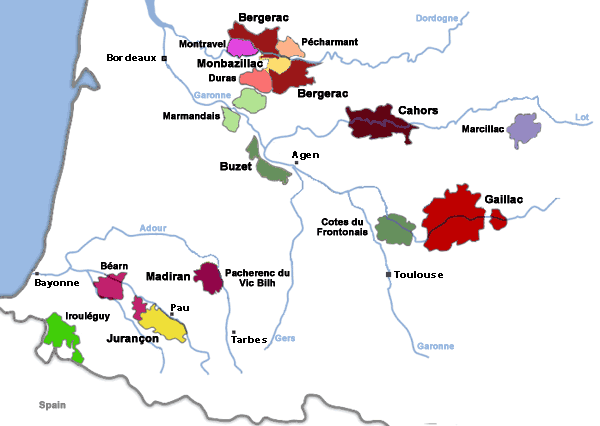


The varietals for this wine are Semillon, Sauvignon, and Muscadelle, the last of which is particularly successful in this region. The most interesting aspect of these wines is not, however, the varietals themselves, but rather what happens to them prior to being picked. Due to the appellation's geographic location, there are often morning mists followed by warm and sunny afternoons throughout autumn. These conditions are perfect for the development of Botrytis cinerea, or noble rot. While this fungus may lead the grapes to look downright disgusting, the resulting wine can be profound. Read a few reviews of Chateau d'Yquem -- the famous wine from Sauternes -- and you will get an idea of just how phenomenal an experience botrytized wine can be.


Although there are a number processes that take place when noble rot affects grapes, the most important are as follows: the grape loses more than half of its water content as it shrivels into something more akin to a raisin, the sugar becomes concentrated, and the phenolics in the grape skins are broken down resulting in the release of the tannins into the juice. There are thus a variety of viticultural strategies that must be employed to extract wine from these severely dehydrated grapes. Due to the fact that not all grapes are affected by noble rot at the same rate, numerous passages through the vineyard must be made to ensure consistency. Once picked, the grapes must also be pressed numerous times to ensure that the little remaining juice can be extracted. Not only that, the fermentation proceeds very slowly: the high sugar levels and the presence of antibiotics like botryticine severely inhibit the yeasts. All this to say, making these wines is an expensive prospect. When one also considers that the whole process can be undermined by uncooperative weather conditions, the fact that botrytized wines are often exorbitantly priced makes a good deal of sense.


Chateau de Monbezillac, as the name indicates, is the largest producer in the appellation. A gorgeous estate that features a 16th century castle, much about about this producer recalls the better known chateaus in Barsac. And although 2001 was not one of their best vintages, it was by no means a disaster either. More than anything, it represents a great opportunity to sample a special and rare style of wine at a reasonable price. It comes in a 500ml size, which is the perfect amount to enjoy with a selection of strong cheeses, particularly those of the blue variety. It would also pair well with foie gras should you prefer to serve it with a first course. Either way, you're in for a treat.


As a final note, botrytized wines are known for their ability to age for extremely long periods of time, generally progressing to saturated honey and nut flavours. Although you won't get the 100 some odd years out of this that you would from a d'Yquem, if you have the patience, it would surely reward 15-20 years.

For further information on noble rot, please see Janice Robinson's The Oxford Companion to Wine, from which much of this entry is culled.

Friday, November 16, 2007

Vintages Selection: Domaine Santa Duc Gigondas 2004

With the November 24th Vintages release about a week away, it is a fine time to bring to your attention one of the great values on the way. Although the release itself is not one of the most exciting overall, the availability of Domaine Santa Duc's standard Gigondas cuvee is certainly something to look forward to. Along with Montirius, Domaine la Garrigue, and Domaine les Pallieres, Santa Duc is one of my favourite wines from the region. And I am not alone: Robert Parker and the Wine Spectator have consistently rated their wines in the 90+ range. Whether you are a fan of these reviews or not, they do highlight the consistent quality level of the wine produced at this estate.


Domaine Santa Duc Gigondas 2004 33.95 (#11601)

Having not had the pleasure of visiting Santa Duc, I cannot relate a great deal of first hand information about the producer. I have, however, been to Gigondas (both the appellation and the town), and thought I might share a little bit of information about the terroir. Gigondas is located to the northeast of Chateauneuf-du-Pape and shares a few of the same characteristics: most notably the stony soil and the lengthy exposure to the sun. But unlike the majority of vineyards in its more famous cousin, many vines in Gigondas are planted on slopes. The wines of this region are often referred to as 'rustic,' and this accurately describes the landscape as well. One need only look at the Dentelles de Montmirail that overlook many of the vineyards, to gain a grasp of how rocky the region is.


The cuvee for Santa Duc's standard bottling of Gigondas is 75% Grenache, 10% Syrah, 10% Mourvèdre, and 5% Cinsault, which is quite standard for the appellation. One of the noteworthy aspects of this blend, however, is that the grapes are sourced from a number of different vineyards throughout the commune. The producer believes that this ensures consistency from vintage to vintage, but it also helps to provide balance in a given year as well. Five of these vineyards are based on quaternary red clay stony soils -- “Hautes Garrigues”, “Carbonnieres”, “Rocassieres”, “Santa Duc”, and “Pailleroudas” – while the “Goujard et Plane” vineyard lies on calcarous clay soil. Blending of this nature is an excellent way of expressing the terroir of the appellation, rather than just a single vineyard.


The high percentage of Grenache in the blend leads to concentrated notes of red and blue fruits that give the impression of sweetness. And like many of the best wines from the Southern Rhone, there is a distinct stoniness on the palette. More importantly, perhaps, is the fact that the tannins in this wine are not overpowering, meaning it can certainly be enjoyed in its youth. Having said that, this wine is a perfect candidate for mid-term cellaring, and will no doubt improve with five or so years of aging. At less than 35 dollars, the quality-to-price-ratio of this offering is nothing short of excellent. Drink up!

Please visit Santa Duc's website for additional information (www.santaduc.fr).